
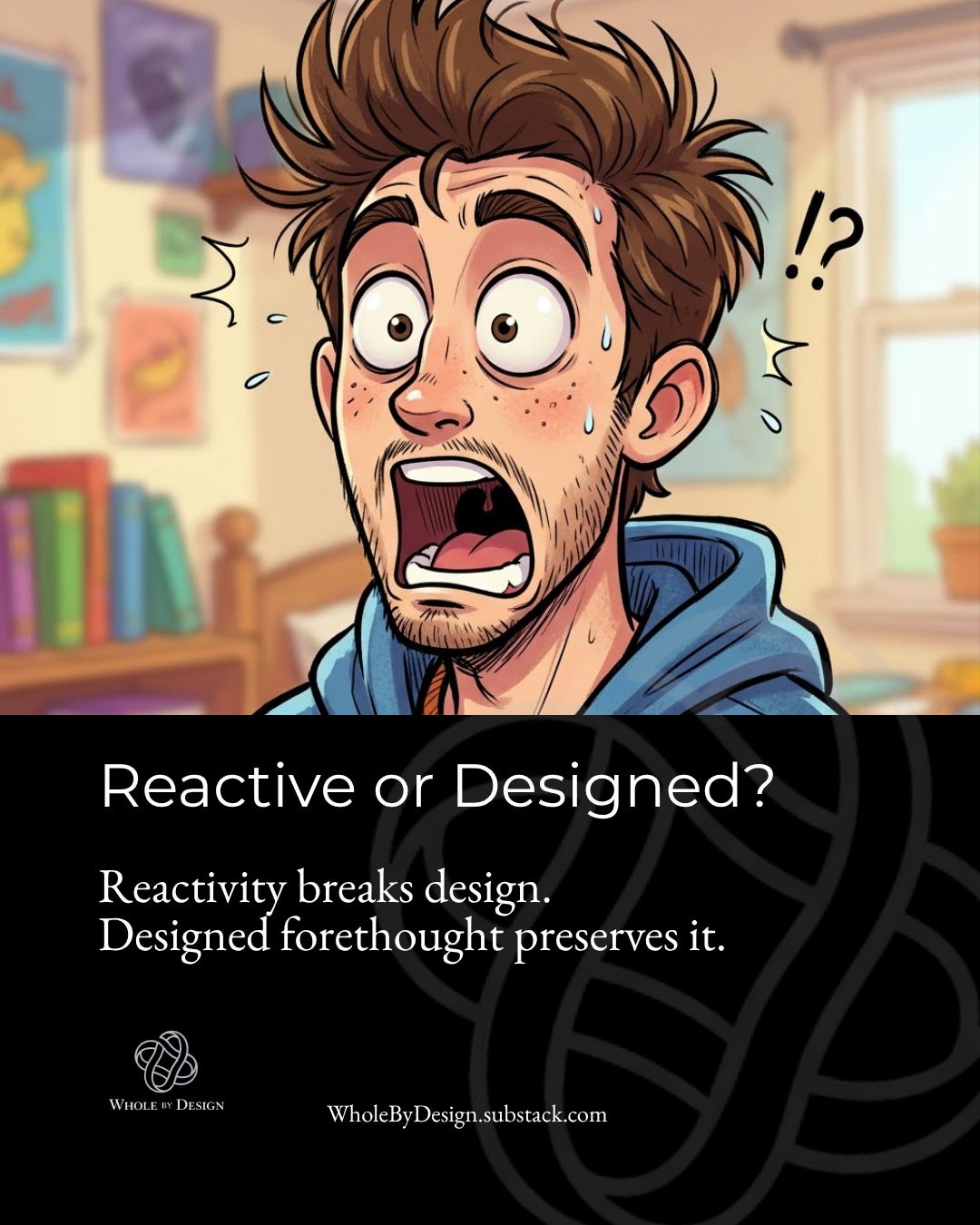
Reactive or Designed?
Reactivity breaks design. Designed forethought preserves it.

Flourishing is humanity’s original design.
There are two ways to move through the world. When discomfort, problems, or shortcomings appear, we can isolate them and react. Or, we can step back and see how they fit into the whole.
One way is fast, instinctive, and emotionally satisfying.
The other can feel slow; but is intentional and quietly powerful.
One reacts to what’s on the surface.
The other considers the architecture beneath it.
One stacks on layers to soothe discomfort.
The other protects coherence so the system stays whole.
Most people live in the first mode.
The second keeps systems Whole By Design..
This essay is about the difference.
Having observed how Additive Interventionism compromises macro systems and public policy, the challenge is to recognise this pattern wherever it appears and avoid defaulting to it. How do we spot the universal tendencies to drift before we intervene, and what does it take to choose design over reflex?
One stacks on layers to soothe discomfort.
The other protects coherence so the system stays whole.
Reactivity:
The Fastest Way to Break Design
Reactivity feels natural because it is immediate. Something hurts, so we fix the part that hurts. Something feels off, so we intervene. Something drifts, so we add a layer to stabilise it.
Reactivity is:
fast
emotional
fragment‑focused
short‑term
optics‑driven
comfort‑seeking
It responds to the visible symptom, not the underlying architecture.
Reactivity is what makes us:
add rules instead of examining motives
add features instead of addressing architecture
add coping mechanisms instead of addressing identity
add supplements instead of anchoring to foundations
add processes instead of clarifying purpose
Reactivity is the engine of drift.
It pulls systems away from their design because it treats a part, not the whole. It soothes the discomfort of the moment but erodes the coherence of the system.
Reactivity breaks design. Not through malice, but through haste.
Reactivity breaks design. Not through malice, but through haste.
Designed Forethought:
The Posture That Preserves Design
Designed forethought is not slowness for its own sake.
It is patience to function out of clarity.
It is the discipline of asking:
Why does this problem exist?
How did it start becoming an issue? Was it always an issue or did an external shift introduce it?What is the architecture beneath it?
Does the original design factor this need?What is the system context?
How does this new issue fit into the whole system?What would maintain coherence rather than disrupt it?
What intervention preserves design rather than distorts it?
Designed forethought is:
architectural
whole‑system
patient
discerning
purpose‑aligned
protective
It doesn’t rush to intervene.
It doesn’t confuse discomfort with failure.
It doesn’t confuse visibility with importance.
Designed forethought preserves design by keeping the system aligned with its purpose. It prevents drift before drift begins. It protects coherence before complexity accumulates.
It is the posture that keeps a system whole.
Designed forethought is not about control.
It is about stewardship.
Why Modern Life Trains Us to React
Reactivity is rewarded everywhere:
speed is praised
visible action is celebrated
optics matter more than architecture
short‑term reassurance feels like progress
discomfort is treated as a crisis
slowness is mistaken for incompetence
We live in a culture that values movement over direction, and activity over alignment.
In such a world, designed forethought looks strange.
It looks like hesitation.
It looks like “doing nothing.”
It looks like inefficiency.
But it is the only posture that protects design.
The Cost of Reactivity Is Drift
Every reactive fix introduces a small distortion.
Every distortion compounds.
Every compounded distortion becomes drift.
Drift shows up as:
organisational drift: processes that no longer match purpose
relational drift: conversations that avoid what matters
personal drift: coping mechanisms that replace identity
ecological drift: interventions that treat symptoms, not environment
spiritual drift: rules that replace relationship
Drift is rarely dramatic.
It is quiet, incremental, and cumulative.
Reactivity accelerates it.
The Reward of Designed Forethought Is Wholeness
Designed forethought doesn’t just prevent drift.
It preserves the integrity of systems.
It keeps:
organisations aligned with their purpose
relationships aligned with their truth
individuals aligned with their identity
ecosystems aligned with their nature
communities aligned with their values
Designed forethought is not about control.
It is about stewardship.
It is the posture that keeps a system whole by design.
The Real Difference Between the Two
Reactivity asks:
“What do I need to fix right now?”
Designed forethought asks:
“Is adjustment needed and if so; what will keep original design alignment?”
Reactivity focuses on fragments.
Designed forethought sees the whole.
Reactivity adds layers.
Designed forethought protects architecture.
Reactivity soothes discomfort.
Designed forethought preserves coherence.
Reactivity breaks design.
Designed forethought keeps it intact; and makes it better.
Keeping It Whole
This is the heart of Whole By Design. In one of my previous essays, I defined Additive Interventionism as our reflexive human tendency to meddle by adding layers. To stay away from that trap, we must change our daily posture.
Flourishing is not something we achieve by reactively adding more.
It is natural when we are aligned with our design.
Reactivity pulls us away from that design.
Designed forethought keeps us within it.
This is not about perfection.
It is about posture.
A way of seeing.
A way of choosing.
A way of moving through the world that protects what matters.
PAUSE!
The Next Time You Catch Yourself Reacting…
Do this instead: Fight the urge to fix something immediately.
Before you act, ask yourself:
What am I reacting to?
Is it discomfort, dislike, or an actual architectural failure?Is the system doing what it is meant to?
Every system has a design logic. See it before you intervene.How and where would any change affect the system as a whole?
Understand that an issue is likely related to the whole system in more ways than one. Mapping this out before proposing changes.What would preserve coherence rather than add complexity?
Choose the move that keeps the system whole, not the one that makes it busier and more fragile.
Take a moment and suppress the urge to react.
Let the discomfort teach you something about the design.
Let forethought replace reflex.
This pause is not passivity.
It’s the moment where design is preserved instead of broken.
This pause is not passivity.
It’s the moment where design is preserved instead of broken.
The Quiet Power of Designed Living
Most people live reactively because it feels responsible.
But reaction without architecture is motion without precision nor purpose.
Designed forethought is quieter.
Less dramatic.
Less visible.
But it is the posture that keeps systems whole, relationships pure, organisations coherent, and lives aligned.
It is the posture that preserves design.
After all, flourishing is humanity’s original design.